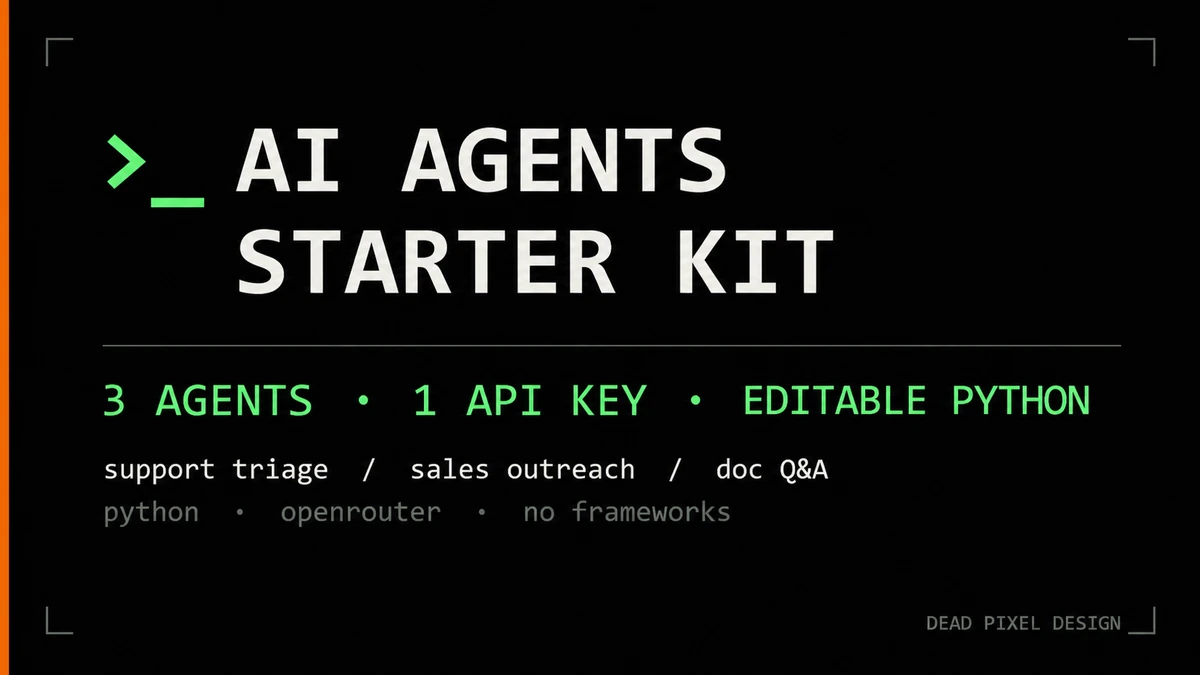
AI Agents Starter Kit
Three working Python AI agents for support triage, sales outreach, and document Q&A. No LangChain or vector database required.
Inputs
- ticket text
- prospect description
- .md and .txt files
Outputs
- JSON triage
- cold email
- cited answers
Three working AI agents you can run in 60 seconds. No SaaS subscription. No LangChain. No vector database. Just three Python files that use OpenRouter and do real work.
What’s in the kit
Support Triage Agent. Reads an inbound ticket, returns category, urgency, sentiment, suggested owner, and a draft reply, all in clean JSON.
Sales Outreach Agent. Takes your offer plus a prospect description, returns a 120-word cold email with a sharp angle, plus the research gaps you should verify before sending.
Doc Q&A Agent. Answers questions across .txt and .md files in a folder. Cites sources by number. Refuses to invent answers when the docs don’t contain them.
Who this is for
- Solo founders and indie devs who want to ship AI features without the SaaS tax
- Agencies who want to automate first-line support, SDR, or internal Q&A for clients
- Builders who want to learn agent patterns without LangChain getting in the way
Who this isn’t for
- People who want a hosted SaaS dashboard. This is code you run on your own machine.
- People who don’t want to touch Python. You don’t need to know it well, but you do need to be willing to open a file.
What you get
- Full Python source for all three agents
- Polished system prompts you can edit in markdown
- One-click Windows .bat launchers
- 15 example inputs and outputs across the three agents
- README and LICENSE
- The cleanest OpenRouter wrapper you’ve ever read
AI Agents Starter Kit vs the obvious alternatives
| AI Agents Starter Kit | LangChain agent tutorial | OpenAI Assistants API | |
|---|---|---|---|
| Cost | $19 one-time | Free reading, your time | Per-token pricing |
| Cost to run | Depends on your OpenRouter model | Depends | Always paid |
| Lines of code | ~400 plain Python | Thousands across many files | Hosted, opaque |
| Frameworks | None | LangChain, often more | OpenAI lock-in |
| Time to first run | 60 seconds | An afternoon | Account setup, API keys, billing |
| Provider lock-in | None, OpenRouter routes to any model | None | OpenAI only |
How to run the AI Agents Starter Kit
- Step 1 Install Python
Install Python 3.11 or newer from python.org. Check "Add to PATH" during install.
- Step 2 Get an OpenRouter key
Sign up at openrouter.ai/keys. No card needed. The free models are capped at 50 requests a day until you've bought $10 of credit at some point, which raises it to 1,000.
- Step 3 Save the key
Save the key to a file named openrouter-api.txt on your Desktop. The kit's loader finds it automatically.
- Step 4 Run setup
Double-click setup.bat. It creates a Python venv and installs the only dependency (requests).
- Step 5 Run any agent
Double-click run_support_triage.bat, run_sales_outreach.bat, or run_doc_qa.bat. Each prompts for input, runs the agent, prints the result.
Common questions
Where do I buy this?
Direct checkout is paused while I verify the current runtime claims and download. Use the email button on this page and I'll send the release link when it's ready.
What does it cost to run?
OpenRouter caps its free models at 50 requests a day if you've never bought credits, and 1,000 a day once you've bought at least $10 of credit at any point. Both tiers cap at 20 requests a minute. Those were OpenRouter's published limits on 2026-08-11 and they change them from time to time, so check before you plan a week of work around them. If you outgrow the free models, the shared client switches to a paid model in one line and you pay OpenRouter directly, not me.
Why no LangChain or vector database?
Plain requests plus json does the job in 400 lines of Python you can read in 20 minutes. Frameworks make agent code 10x harder to reason about and break every six months.
Can I use this in commercial work?
Yes. The license allows commercial use, modification, and use inside paid client work. You can't resell or relist the kit itself.
Does the Doc Q&A agent need a vector database?
No. It loads .txt and .md files from a folder, scores chunks against your question with keyword matching, and sends the top 4 to the model. Zero setup. For very large corpora you can swap in embeddings later.
What if free models go away?
The fallback chain has six. New free models appear on OpenRouter regularly. The auto-router picks an available one for you. If everything free disappears, one line gets you on a paid model.