Visit Milo, Maine
A town site for Milo, Maine. Residents and local businesses submit events and listings, volunteers approve them, and the committee runs it themselves.
Visit Milo gives a small Maine town one public place for events, local businesses, recreation and photos. Residents write the content, a few volunteer moderators approve it, and the committee runs the site day to day.
What was going on in town had no home
Milo is a small town in Piscataquis County, at the spot where the Sebec and the Pleasant meet the Piscataquis. Friends of Milo, a volunteer nonprofit committee, wanted one public site for events, local businesses, recreation, links and photos. What was happening in town was spread across Facebook and a static town website that had fallen out of date.
One volunteer webmaster can’t keep a site current by hand. The committee also wanted something separate from the existing community board, and something solid enough to point to in a Maine Office of Tourism grant application.
Residents write it, moderators approve it
The site only stays current if the people in town keep it current, so that’s how I built it. Anyone can submit an event from the calendar, no account needed, and businesses can send in their own listings. Nothing goes up until a volunteer moderator approves it, usually within a day or two, and the approval queue works from a phone.
There are no comments anywhere on the site. That was a decision, not an oversight. Two or three volunteers are the bottleneck, and anything that adds to their queue has to earn its place.
A calendar that works on a phone
Most of the people using this are Milo residents on their phones, and a lot of them are older and not technical. WCAG 2.1 AA accessibility was a stated requirement from the start. Visitors to the area matter too, but they’re secondary.
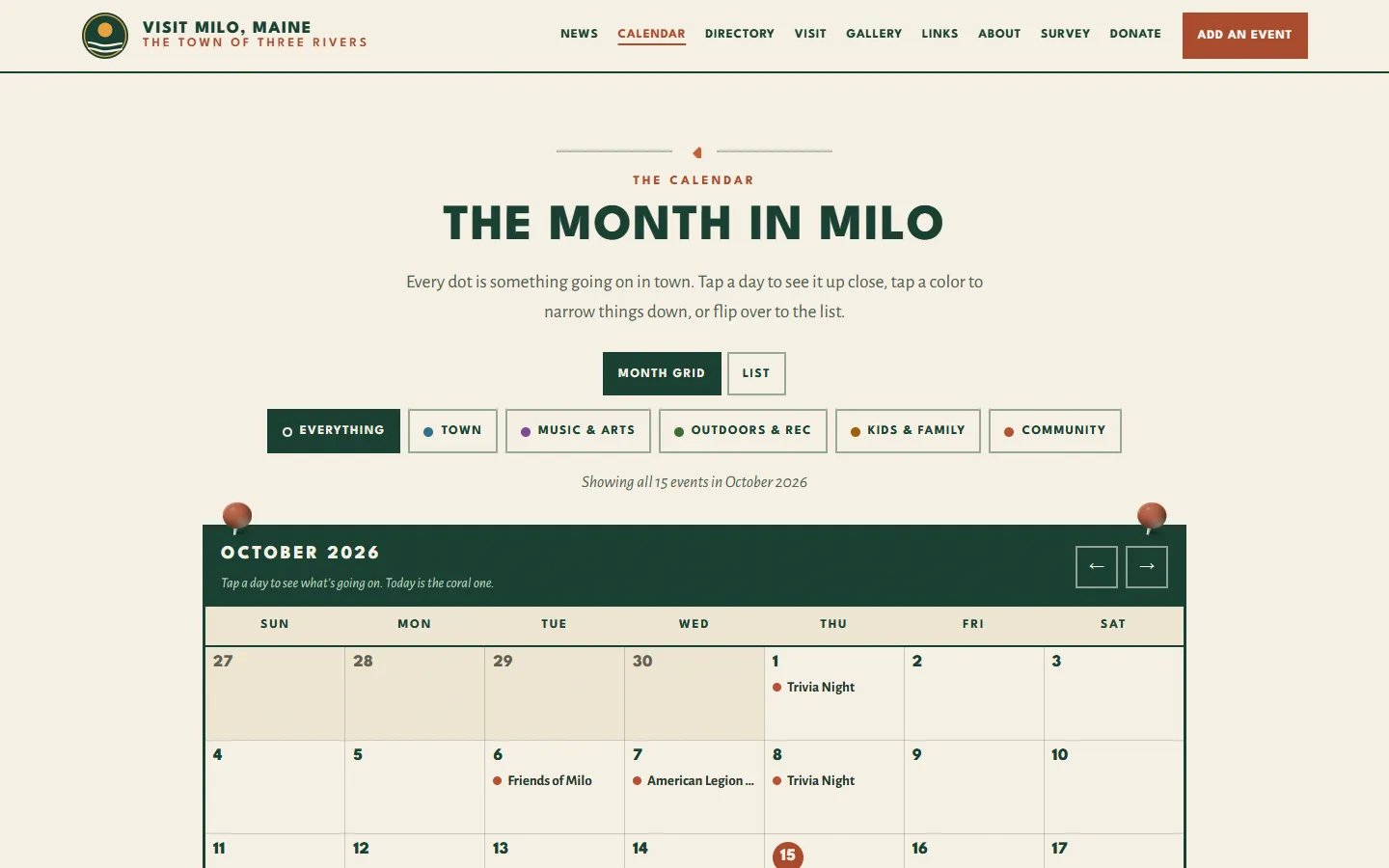
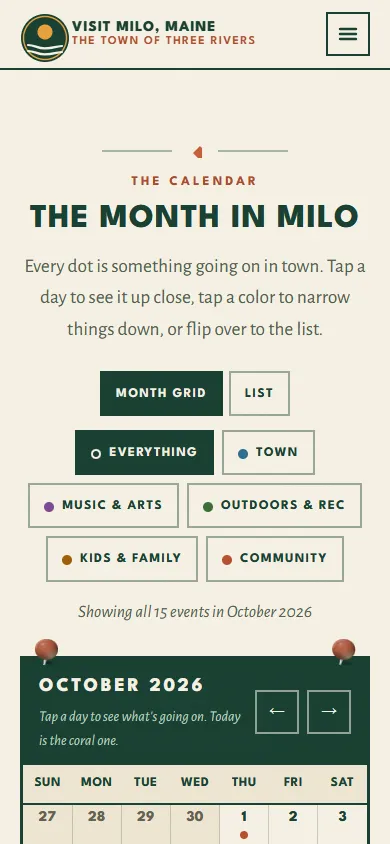
The committee wanted a real month grid as the default, with a list view behind a toggle, so that’s what it has. Events are color-coded by category: Town, Music & Arts, Outdoors & Rec, Kids & Family, and Community. A seven-column grid on a phone leaves about 48 pixels per day, which is too small for event titles. On a phone each day shows category-colored dots, and tapping a day opens its events underneath. On desktop the cells show the titles.
The rest of what a town needs
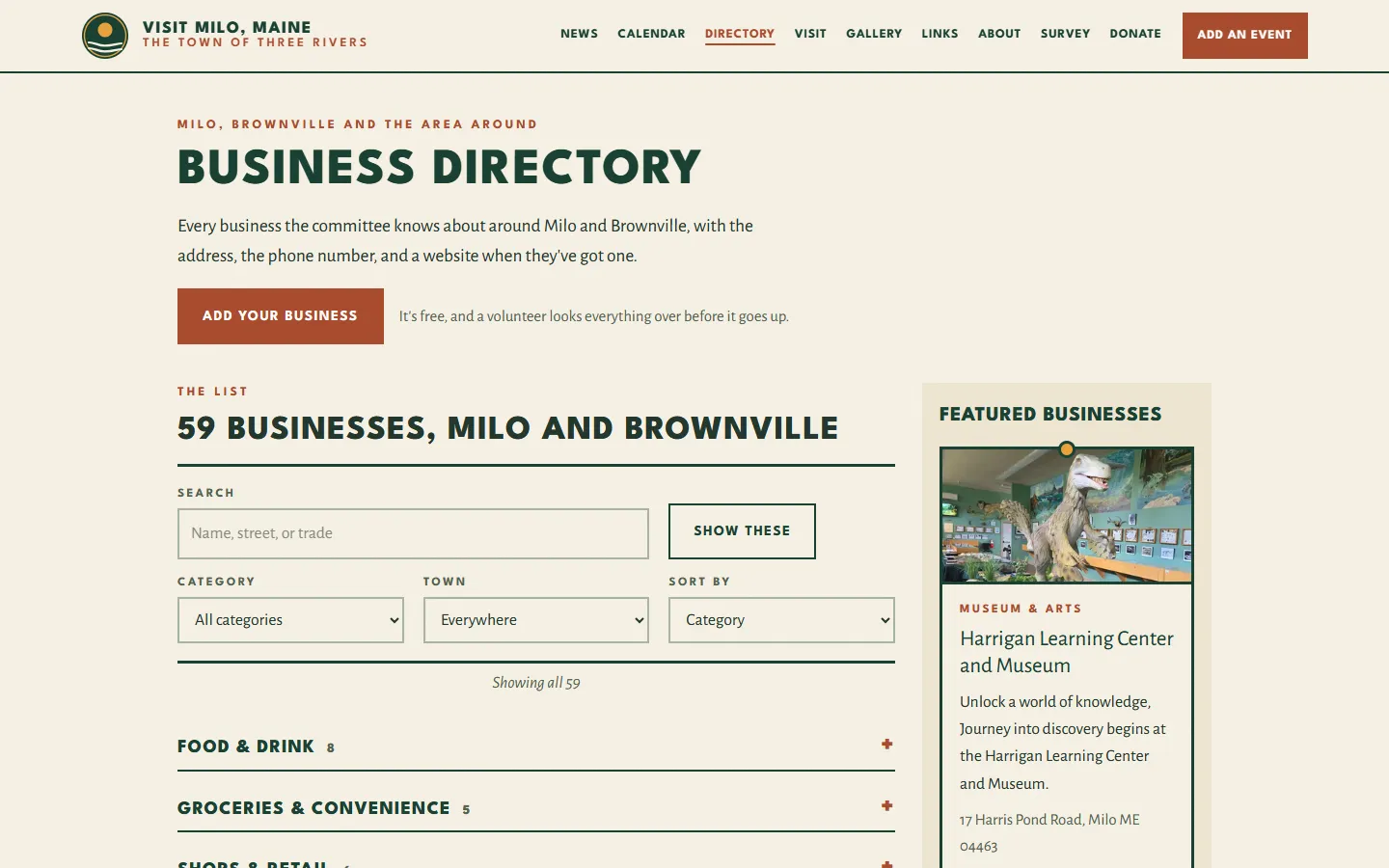
The business directory lists 59 businesses across Milo and Brownville. It’s searchable and filters by category and town, with a featured band at the top. A business can submit its own listing for free, and a volunteer reviews it before it goes live.
The site also has local news posts with photos, a Visit page covering places to stay and things to do, a photo gallery, a Links page, a survey, and a donate button tied to the committee’s own Stripe account. The committee edits the Visit and Links pages itself from a dashboard, where they also approve submissions and post news. Staff accounts use two-step sign-in.
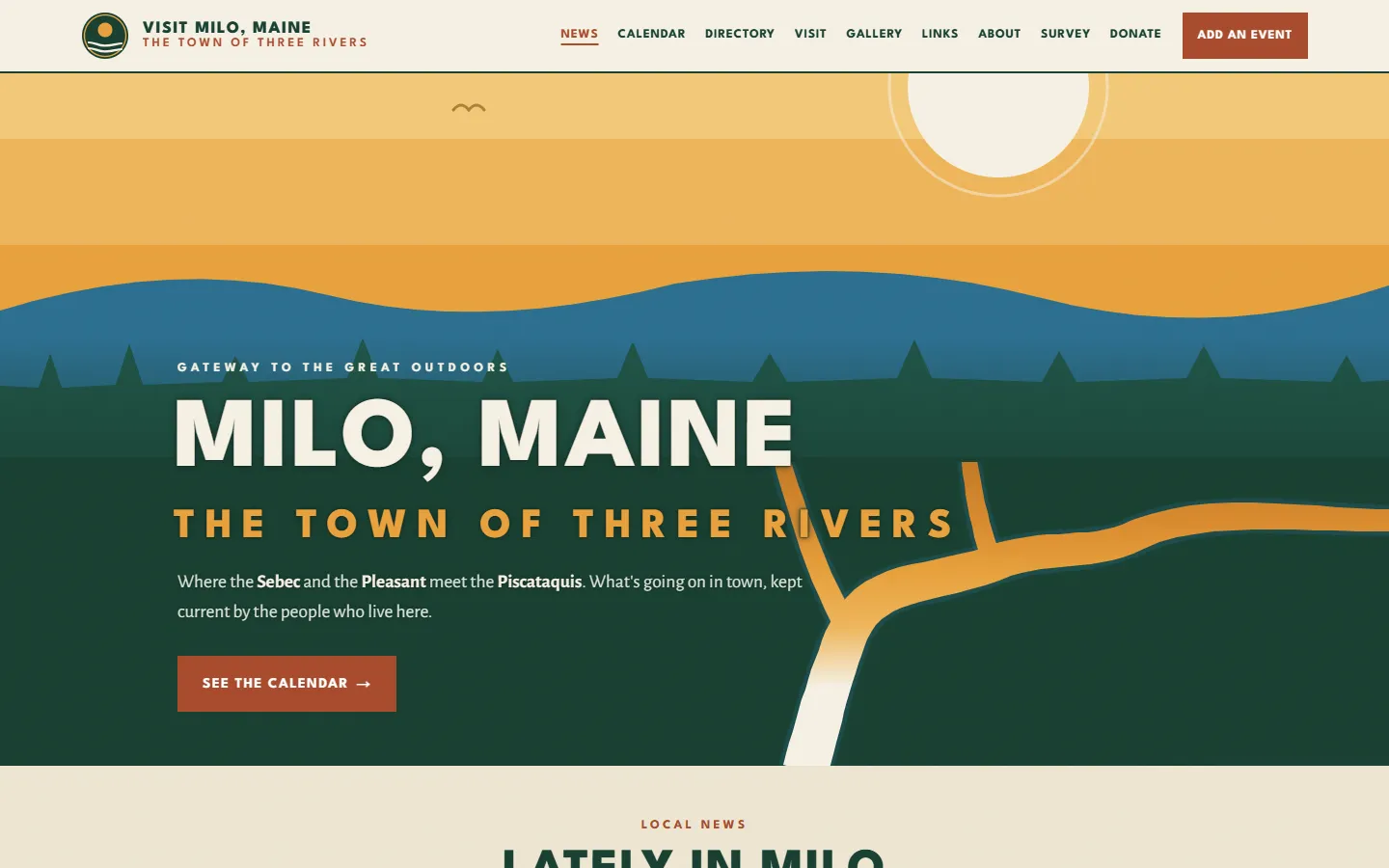
The design starts from an illustrated hero of the three rivers meeting under a low sun, in warm cream, forest green and amber, with a calendar styled like a pinned poster. I also added structured data for events and businesses, a sitemap, and fast pages. The committee hadn’t asked for search visibility, so I put it in scope myself.
How it got built
I started with discovery notes and a Zoom with the committee. Then I made three clickable homepage concepts for them to choose from, and wrote a grant-ready proposal before any build work. Committee decisions arrived between Zoom calls, and the build kept moving as they did.
Before launch I ran hard reviews of my own build, looking for anything that would break or confuse someone, and fixed 19 of the 21 findings. The site launched on October 13, 2026 at visitmilomaine.org and was unveiled at the select board meeting the next day. That same day the committee asked for a Links page, and it was live by the afternoon.
What the work proves
The domain and the site belong to the committee. The registrant is Friends of Milo, and they run the day-to-day content themselves, with no webmaster needed to change a date or approve an event.
There’s no invented traffic number attached to this case study. The evidence is a live site, a moderation flow a few volunteers can keep up with, and a committee that asks for a change in the morning and sees it that afternoon.
See web app development for the service, or website design across Maine for a site built around your town or business.
Need help with a job this clear?
Send the current situation, the business problem, and the result the work needs to produce.